


The mind is a master storyteller. It tells stories about who we are, what we need, and what others think of us. Here are some of my stories:
“I am Meghana. I am from Bangalore. My parents live far away; I wonder how to care for them. I have a sister. I love to dance; I should dance more. I am a yoga teacher who went to business school – that was not easy.”
We all have stories like these, and most of the time we take them to be who we are.
Every night though, when we sleep, the story disappears. The story is only active as long as our minds are. The rest of the body works without the story. Our lungs keep breathing, our hearts keep beating, our digestion keeps going – without the story. If so much intelligence is working in us, whether or not it’s aware of our stories, these stories are a very limited way of defining who we are. If we are more than our identity stories, who are we? This question is where the journey of wisdom begins.
Wisdom is the clarity that emerges from being. It is not something we acquire from external sources. Rather, it is intrinsic to every human being and tends to surface when a few conditions come together:
- genuine curiosity about who we are;
- settling our nervous system through rest, nourishment, movement, and silence;
- immersion in nature; and
- trusted guides who help us return to our innate capacity.
Me-centric mind vs wisdom-centric mind
Most of us default to making our stories the reference point through which we interpret experiences – in other words, we operate from a me-centric mind. We interpret other people’s behavior as a reflection of our worth and life’s outcomes as a measure of our abilities.
For instance, if someone we know doesn’t wave back to us on the street, a “me-centric” mind might feel insecure and think, “Have I done something wrong?” The next time we meet them, we may be more reserved or cautious with our affection, or swing the other way and become overly interested to compensate for not knowing where we stand with this person. We calibrate our behavior based on others’ reactions – an energy-intensive endeavor.
A wisdom-centric mind, by contrast, is more discerning. It personalizes less. It allows us to see things as they are, uncolored by our own egos. External situations do not define its self-worth or disturb its peace. It is open to the possibility that lack of reciprocity might have nothing to do with us. It is also open to the possibility of genuine disconnect. Either way, how it shows up for the other person does not change.
Learning to default to our wisdom-centric mind as opposed to our me-centric mind lowers our need to fight reality and fosters more acceptance of our circumstances – whether we like them or not. We are consistent in who we are regardless of how others respond. We navigate what comes our way with greater levity, freedom, and conviction.
The need for wisdom-centricity in our lives
When we are me-centric, most of us make decisions based on our identities and desires. This is an egoic experience of life. It is bound to create restlessness that shows up in different ways. We can view every win as proof of our self-worth, and every setback as a threat to it. We can feel we need more than we currently have to be happy, and constantly raise the bar for contentment: “If X happens, I will be happy”. We start experiencing our days as “good” and “bad”, stuck in cycles of highs and lows. When others win, we may struggle to be genuinely happy for them or feel like we are not doing enough in our own lives. We may serve others only when it makes us feel good in the moment. And when we do help another, we may feel we are owed something in return. These are all manifestations of me-centric restlessness which, despite our intentions to be peaceful, generous, and helpful, keeps us in constant discontent.
Wisdom-centricity lets us hold our desires and identities lightly. We can pursue extraordinary goals with full commitment and still stay free inside.
The need for wisdom-centricity in our products and institutions
Whoever designs a product, organization, policy, program, or space builds their state of consciousness into it.
- A leader who believes no one else can do the job right builds a team culture where people do not step up.
- An education that rewards only right answers produces leaders afraid to say, “I don’t know.”
- Funders who reward the most compelling story incentivize organizations to get good at telling stories about their work, not necessarily those who do better work.
- Products designed to capture attention shape what billions see, desire, and choose, eroding human agency.
Each of us is building the world, every day. Over time, our micro-decisions shape what thousands of people experience, believe, and do.
When architects design from wisdom, the cultures, incentives, and spaces they create help everyone inside them evolve towards greater freedom.
Pathways to wisdom: a philosophical framework
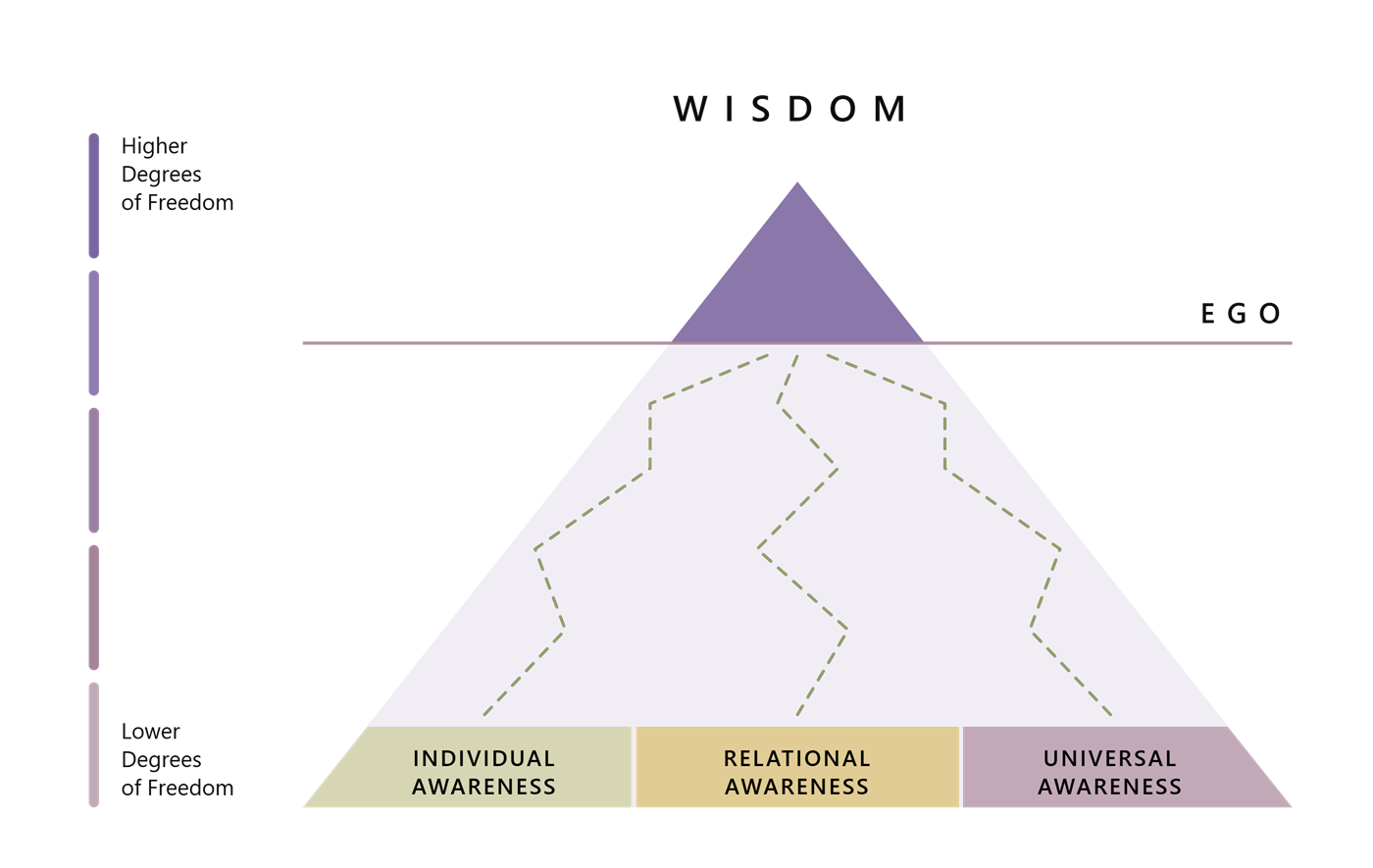
So how can we get there? Wisdom comes from transcending constant mental narratives about ourselves, others, and the world. This can happen through three types of awareness journeys:
- individual awareness, seeing the patterns of our own minds clearly, and becoming a witness to our own thoughts, emotions, and stories.
- relational awareness, consistently meeting others with intention, without our own interests as the primary reference point.
- universal awareness, recognizing the larger, interconnected field of intelligence we participate in, and living a life that honors it.
These journeys are interconnected, and improving one often creates ripples that improve the other two. This is because all three awareness journeys share one thing in common: transcending our egos.
People who embark on the individual awareness journey tend to have reflective and philosophical inclinations or a keen interest in the sciences of the body and mind. Socrates, the Buddha, and Ramana Maharshi are all historical figures who, in their own distinct ways, exemplified this journey. Ramana Maharshi recounts how, at sixteen, he experienced an overwhelming fear of death while sitting alone in his uncle’s house, even though he was perfectly healthy. He decided to investigate this fear on his own. He lay down, held his body as still as a corpse, and asked himself, “…with the death of this body, am I dead?”1 In this inquiry, he discovered an awareness that exists within us that even the death of our bodies cannot perturb. For the rest of his life, he distilled his central teaching into a single question – “Who am I?” To help answer this question, he would often guide students to examine the state of deep sleep – a state where the sense of “I” falls away, and yet we continue to exist.
People who embark on the journey of relational awareness tend to be service-oriented, group-oriented, or interested in studies of interactions. The Ju/’hoansi of the Kalahari built relational awareness into daily life, as anthropologist Richard Lee learned the hard way. One Christmas, he bought the largest ox he could find as a gift for the community. Instead of thanks, he heard one person after another call it skinny, old, and barely worth eating. Lee was hurt and finally asked them why. They explained that when someone brings in a great deal of meat, he can begin to think of himself as a big man and see everyone else as beneath him. So they make light of every gift: “This way we cool his heart and make him gentle.”2 In a community where survival depended on sharing, no single ego was allowed to grow large enough to strain the bonds between people.
People who embark on the journey of universal awareness tend to be oriented towards faith, spirituality, and sciences that explore the fundamental nature of reality and the universe, such as physics, cosmology, and systems science. Einstein’s relationship with spirituality is a fascinating example of universal awareness emerging through scientific inquiry. In his 1930 essay “Religion and Science”, Einstein described what he called the “cosmic religious feeling.”3 He distinguished it from religious experiences centered on personal needs, rewards, fears, or an anthropomorphic conception of God. He described the experience as encountering the extraordinary order and beauty of nature and the universe, and recognizing the limits of one’s individual concerns. He wrote about how individual existence could feel like an imprisonment, and how a person might seek to experience existence as a unified whole. For Einstein, this sense of wonder was also central to genuine scientific inquiry.
Historical accounts like these matter because they show us what’s possible and hold up a mirror to our own potential. Regardless of which awareness journey we start with, the mechanism remains the same. We eventually experience distance from our egos and self-concept. We are no longer limited by mental constructs about who we are and what we have. We discover experientially, not just intellectually, the underlying unity between what we call “Self”, “Others”, and the “Universe”. And when we live our lives honoring this underlying unity, contemplative traditions across the world show what follows: we are powered by the infinite potential and possibilities the universe has to offer.
Notes
- archive.arunachala.org/ramana/life ↩
- Lee, Richard Borshay. “Eating Christmas in the Kalahari.” Natural History 78, no. 10 (December 1969): 14–22, 60–63. ↩
- organism.earth/library/document/religion-and-science ↩