

I remember the first silent retreat I ran with my yoga teacher years ago. I thought it would feel heavy. I wondered whether people would feel connected in silence. I anticipated and mentally prepared myself for dissatisfaction. What I experienced, though, completely shifted my perspective. Silence turned out to be comedic – people noticed the small things about each other that they might have otherwise missed. Like seeing someone look up eagerly at the waiter for the third time, only to realize he was bringing food to the next table again. There’s such a fullness and warmth in the eye contact and smiles that follow, knowing that you both know what just happened. Silence made everyone enjoy the simple things that tend to go unnoticed, and connected them to each other’s depths rather than their shallows.
People’s well-being and wisdom quotients become palpably higher in silence.
In On Wisdom Part I, we covered how me-centricity creates suffering and how wisdom-centricity heralds freedom. We also discussed the three awareness journeys that deepen our wisdom – individual, relational, and universal. Today, let’s look at how to make these journeys real in our daily lives.
Accessing wisdom in daily life
A key doorway to wisdom is accessing the stillness beneath the mind’s constant narratives about ourselves, others, and the world. Different people find their stillness in different ways – time in nature, solitude, silence, sleep, meditation, exercise, music, dance, writing, work; the list goes on.
Some of the world’s most renowned artists, sportspeople, scientists, and leaders have regularly tapped into states of stillness to achieve greatness. The chemical structure of benzene, for instance, had the scientific community baffled for a long time. The German scientist who finally discovered it, August Kekulé, famously described how the structure came to him in a dream. Isabel Allende has openly spoken about spending extended periods of time in solitude to create her novels. Gandhi used to observe a day of silence every Monday, saying, “There is no doubt whatsoever that after every silence I feel recuperated and have greater energy for work. The output of work during silence is much greater than when I am not silent.”
Just as a still lake reflects the sky without distortion, a still mind sees without distortion. This clear seeing is wisdom.
Retreats designed to connect you with stillness are a great way to experience this for the first time because they instantly create distance from our daily stories and habitual mental patterns.
While a retreat can create the conditions for wisdom for a few days, once people return to their real lives, the clarity often fades within weeks. Modern lives and institutions are not designed to let us operate from a place of stillness. Their default is to incentivize so much noise that, without counterbalancing forces, we can easily get carried away into patterns of suffering without realizing it. We must therefore intentionally build into our daily lives the systems needed to sustain wisdom.
The four Ps of wisdom-centricity
Regardless of which awareness journey – individual, relational, or universal – one chooses to undertake, a few ingredients are key to developing our wisdom-centricity. Most of us may know the four Ps of Marketing; here are the four Ps of Wisdom-centricity.
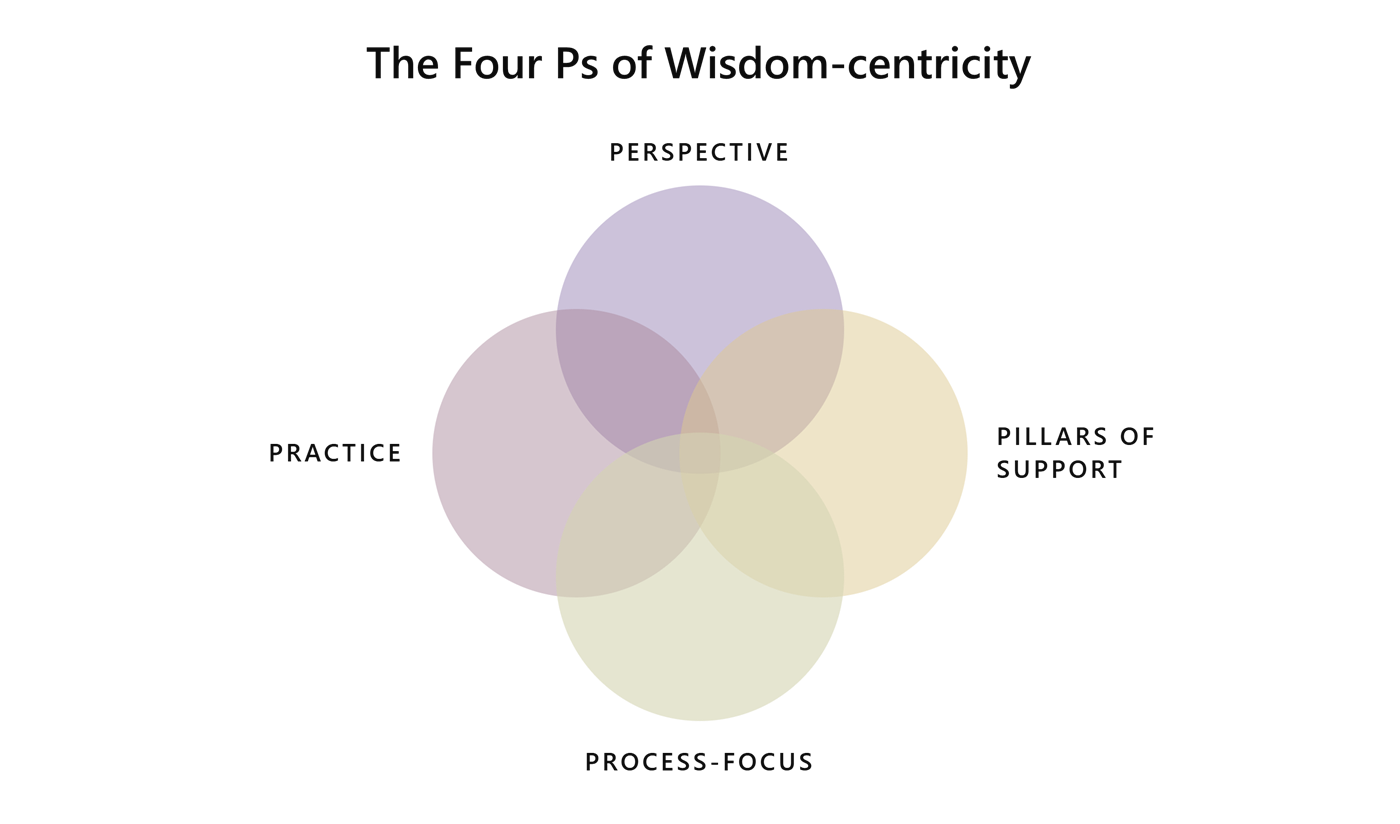
Perspective
Daily knowledge (learning and self-reflection) that helps us question our default ways of relating to ourselves, others, and the world, and slowly helps us become more wisdom-centric in our day-to-day life.
The ancient yogic idea that corroborates this is svadhyaya, meaning daily self-study or scriptural study. In modern times, especially for people with busy, high-intensity careers, I have found consuming relevant content (articles, courses, books, podcasts, documentaries, stories) equally powerful because it can anchor our mind’s existing activity in wisdom philosophy or science. Even one page every day can make a difference. It shifts the lens through which we experience our days and creates an avenue to focus on our wisdom goal in our otherwise easily distracted lives, tempering the monkey mind. Most importantly, it motivates the main lever for wisdom-centricity: practice.
Practice
Everyday use of tools and practices that rewire the nervous system for the stillness from which wisdom stems.
From ancient wisdom traditions (yoga, meditation, mindfulness, energy healing) to modern science (mainly neuroscience, psychology, and flow science), the toolkit is massive and must be intentionally built into how we live, learn, work, and collaborate. Even someone who has read all the scriptures in the world will not necessarily achieve stillness without regular practice. Embodying stillness – not thinking about it, hearing about it, or reading about it – is the only real door to wisdom. We need not cling to rigid ideas of what becoming still looks like, like sitting in meditation for hours on end. This can be rather intimidating, especially for a beginner. There are numerous ways to subtly bring greater stillness into our daily lives – watching our breath while waiting for something instead of looking at our phones, performing daily chores (brushing, making the bed, washing our hands, etc.) mindfully, observing silence for the first couple of hours after we wake or during meals. The idea is to actively counterbalance the mind’s constant need for activity and stimulation. Eventually, our practice becomes so deep and enjoyable that we don’t need external content to motivate us to be still; our nervous system automatically starts to seek out stillness, the way it once sought stimulation.
Process-focus
Devotion to the process and a detachment from results.
This is a critical ingredient because wisdom can easily become another egoic pursuit – we create yet another divide between where we are and where we believe we ought to be, perpetuating the very restlessness we are trying to transcend. Process-focus, therefore, means accepting the variance in daily practice outcomes, without activating self-critique or turning it into yet another thing to chase. This ensures that practice actually stills the mind instead of creating new ripples within it and more me-centric suffering. An effective tool for cultivating process-focus is training yourself to meet both criticism and praise with equanimity. Answer both in the same way: a simple, sincere “thank you”. Avoid deflecting compliments (“oh, it was nothing”) or over-explaining after criticism. Instead, focus on your next step. This trains the nervous system to tame our compulsive need to label outcomes as “good” or “bad” and treat them alike, thereby activating the mindset needed for true process-focus.
Pillars of Support
The communities, mentors and teachers, policies, and convenings that sustain and energize wisdom practice over long periods of time.
Collective will is a powerful tailwind on this journey. Across social movements, spiritual traditions, and recovery communities, we’ve seen how collectives help individuals access capacities that might otherwise remain dormant. Research shows multiple reasons for this, from being motivated by group identity to influencing what we consider normal to feeling a sense of capability that we may not independently experience. The collective helps us keep going when our own conviction and motivation falter. Wisdom in modern lives also needs the right supporting infrastructure. Science has a huge role to play in helping us understand what types of knowledge and tools help which archetypes of people, in what contexts, and in what tangible and intangible ways. Technology can deliver the right personalized support pathways to maintain momentum.
Ultimately, a wisdom journey feels like removing the noise that obscures who we already are. It feels like coming home. We experience a quality of fullness, agency, and contentment within us. And when we operate from this place, how we relate to others, whom we relate to, how we participate in the world, and what we choose to build all change for the better.
Which of the four Ps is missing from your life right now? Start your wisdom journey there.